
buyers choose their supplier before they call a distributor, Bain and Google, 1,208 surveyed
How does a new brand enter the CIS market?
You write to distributors in Almaty and Tashkent. The email is short, the catalogue is attached, the product is good and known at home. The replies come in two kinds, going by our own correspondence with distributors in the region: "send the price list and terms" and "what promotion budget are you giving us". After the second question the conversation usually ends.
The distributor is not turning you down. He is doing the arithmetic. Until his customers ask for your name, your brand is a cost to him. So we enter the region in a different order: presence first, so the people who buy from the distributor recognise the brand, and only then the email to the distributor.
What a distributor actually does
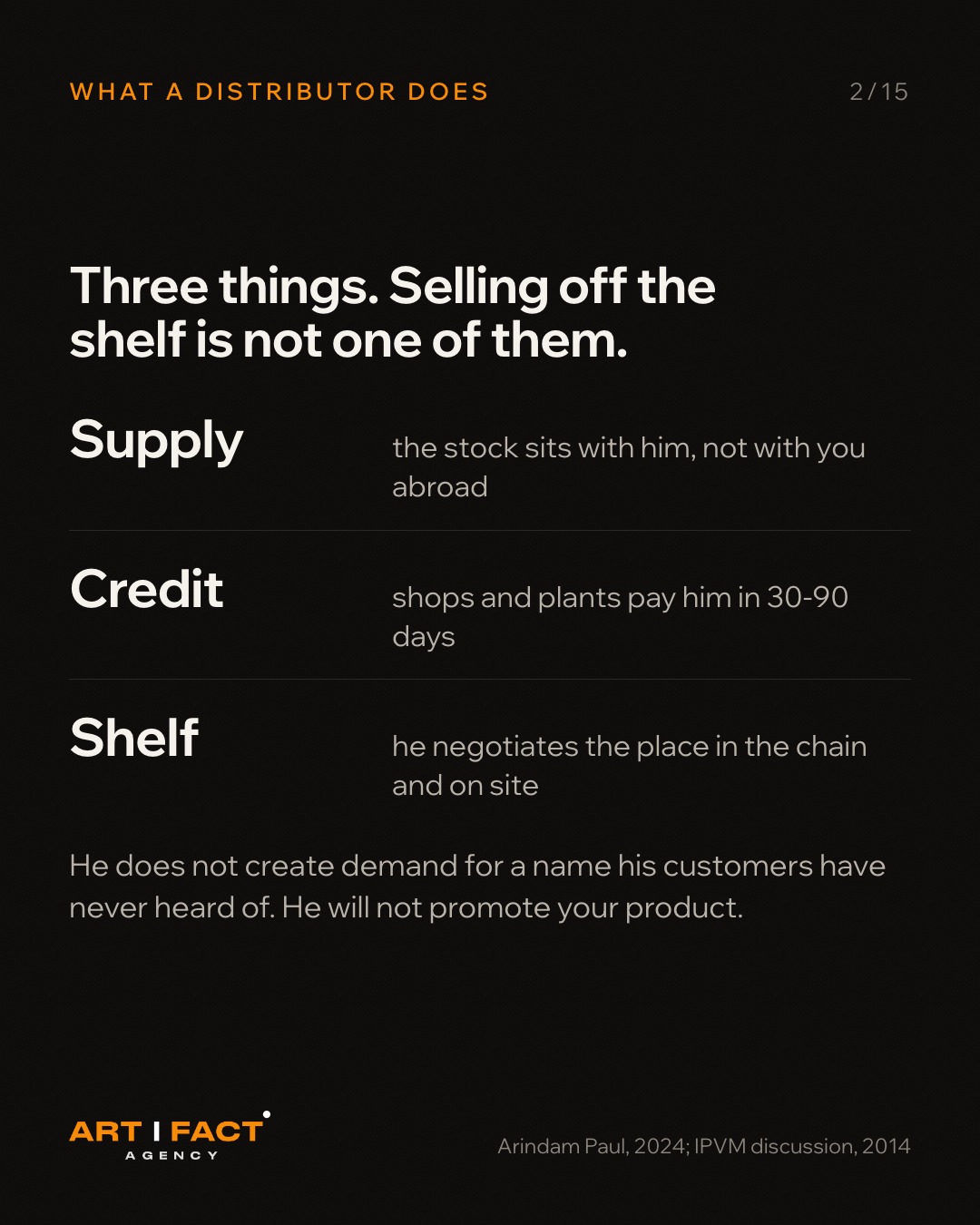
Arindam Paul, a practitioner in India, puts it briefly: a distributor solves three things, supply, credit and placement on the shelf, and never influences how much leaves the shelf. He does not sell to the end customer.
Distributors say the same about themselves. In a discussion on IPVM, where a maker of security equipment asked how to get into distribution, the answer was: a distributor is not a magic bullet, he will not promote your product, and a place in his mailings, catalogues and lunch-and-learns will cost you 5 to 30 thousand dollars a year each. In the same thread a distributor listed what he wants to see from a supplier, and the list includes "existing demand and marketing dollar support". That is the USA in 2014, but distributors have not had it easier since. Charles Bachkora, a distribution consultant, describes today's distributor like this: more brands and SKUs in the portfolio, the same number of sales reps or fewer. Theo Bannink spelled out what follows: without your support the distributor sells whatever sells easiest and earns most.
What he earns and what he spends it on
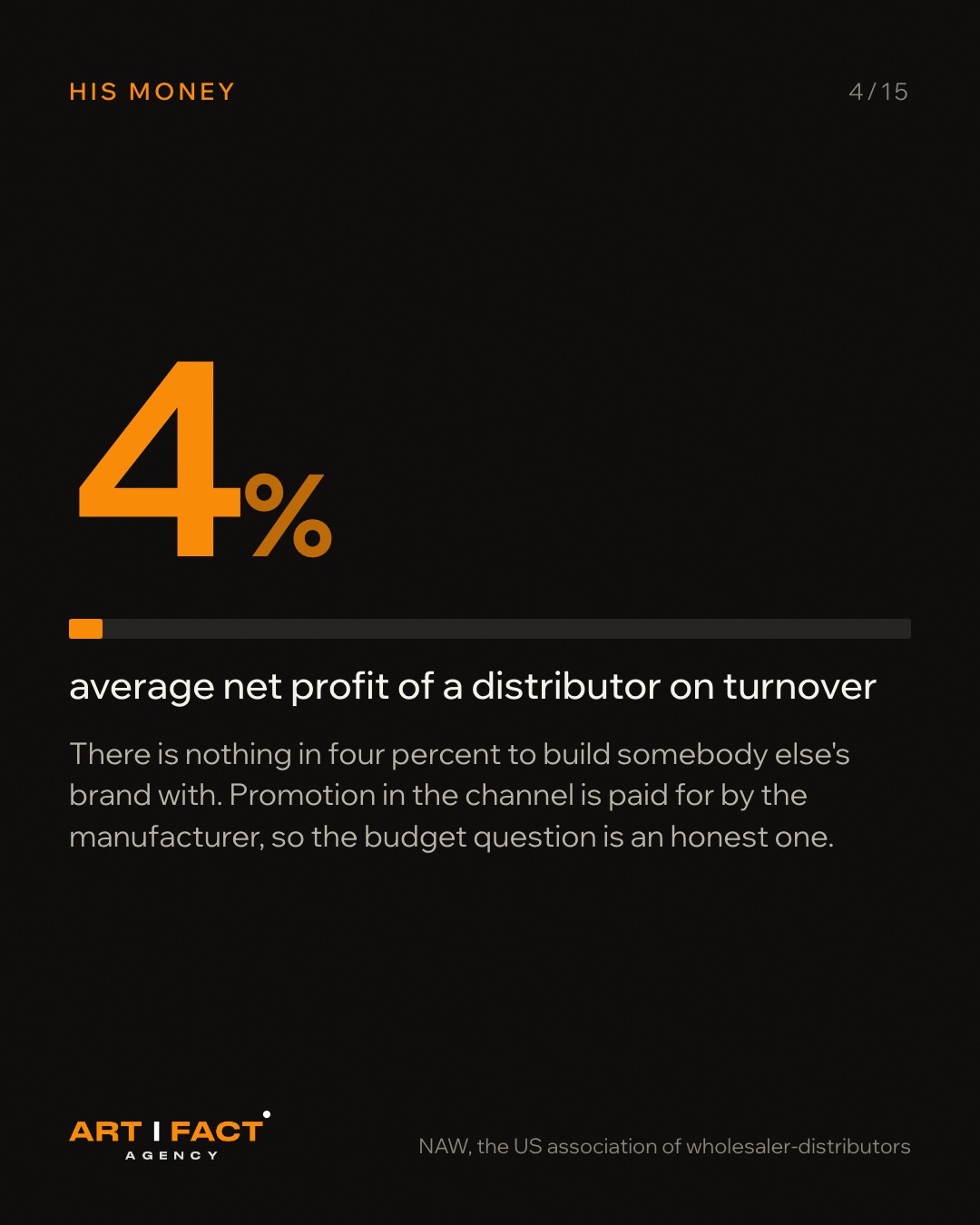
According to NAW, the US association of wholesaler-distributors, a distributor's average net profit is about 4% of turnover. There is nothing in those four percent to build somebody else's brand with.
In Central Asia the fight for the shelf is harder still. I will take Kazakhstan, because it has figures. INFOLine counted more than a hundred large food distributors in 2023, and more than 80% of them work in several channels at once: chains, traditional retail, HoReCa, wholesale. The chains take their share. In March 2026 food producers complained through Kapital.kz that retail chains charge retro bonuses and fees of up to 40% of the product price on top of a 15-20% markup. That is one side of a dispute, but it shows the mechanism: the shelf is paid for.
What a Kazakh retail chain adds to the supplier's price
- Supplier's price100%
- Chain markup15-20%
- Retro bonuses and fees on top of the markupup to 40%
Kapital.kz, March 2026, the food producers' position in their dispute with the chains. Proportions are indicative; both additions are counted on the product price
The distributor does not pay this out of his four percent. He passes it on to the manufacturer. A Russian trade journal for economists breaks down one distributor's quarterly marketing budget: 5.5 million roubles, of which 4 million is the manufacturers' money. One example and another country, but the ratio is typical: promotion in the channel is paid for by the brand.
Where one distributor's quarterly marketing budget came from
- Manufacturers' moneyRUB 4M
- The distributor's own moneyRUB 1.5M
Spravochnik Ekonomista no. 11, 2020, the Rezon group's example for Q4 2020. One example, Russia
This is what your email looks like from the distributor's desk. A name his customers have not mentioned. A product that needs warehouse space, credit terms and a sales rep's time. And not a word about who pays for the shelf. The question about the budget is an honest reply to an email like that.
A known brand has a different conversation with a distributor. Yevgeny Shatokhin of Kosmosystems tells how in 2012 a global cosmetics brand sent him, the future distributor, 16 pages of requirements: for the warehouse, for the training studio, for the number of instructors. A first order of 10 to 40 thousand dollars, purchases from 100 thousand a year. The brand set the terms and the distributor met them, because he wanted that name in his portfolio.
Who actually chooses your brand
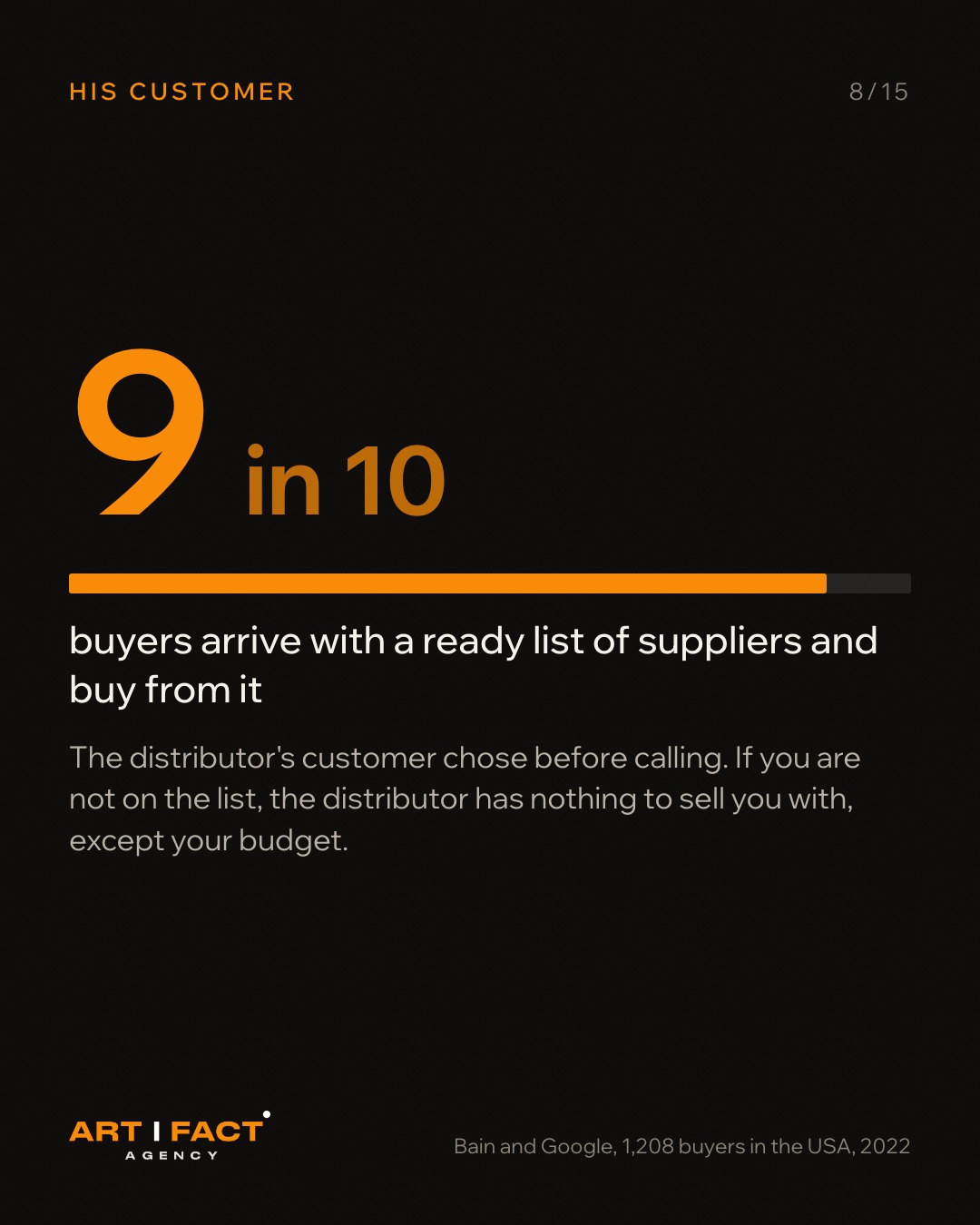
A distributor has his own customer: a plant's purchasing officer, a shop, a restaurant, a construction company. That customer decides which brand he needs before he calls the distributor. Bain and Google surveyed 1,208 buyers in the USA: nine in ten had their list of suppliers before they started researching, and they then buy from that list. 6sense asked four thousand buyers in 2025 and got the same: 94% rank their suppliers in order of preference before the first conversation with a seller.
The distributor's customer chooses before talking to anyone
buyers came to the purchase with a ready list of suppliers and bought from it. 1,208 respondents in the USA
ranked suppliers in order of preference before the first conversation with a seller. About 4,000 respondents, vendor data
actively reject a brand. The other nine in ten have simply never heard of it
The customer arrives at the distributor with a name already. The distributor delivers what was asked for.
Your name is not on that list, and the distributor will not add it himself: there is nothing he can do with you except ask what money you intend to get onto the list with.
Rejection is not what to fear here. Ehrenberg-Bass and LinkedIn's B2B Institute surveyed six hundred or so buyers of business banking in the UK and of business insurance in the USA: about 10% actively reject a brand. Buyers who have never heard of the brand outnumber those who rejected it four to eight times over, and for smaller brands the gap is wider.
The same institute described the 95-5 rule: at any moment 95% of a category's buyers are not buying anything, they will buy later. Their list of suppliers is forming now. You have to get onto it before you need a distributor.
The usual order and ours
The usual way a manufacturer does it: an email to thirty or fifty distributors, a stand at a trade show, waiting. One exporter in Japan wrote about this on LinkedIn: he replaced the question "who will sell our product in Japan" with "how do we create demand before we scale". We answer the second question, only for Central Asia.
to thirty or fifty distributors, catalogue attached
after three or four months of presence, with figures
the pitch up front
the pitch after the reply
or nothing
and pieces written for his market
a new name to his customers
Instagram, Telegram, ads aimed at buyers in the category
and the conversation ends
how many people saw it, how many wrote in themselves
Our own practice, not industry statistics
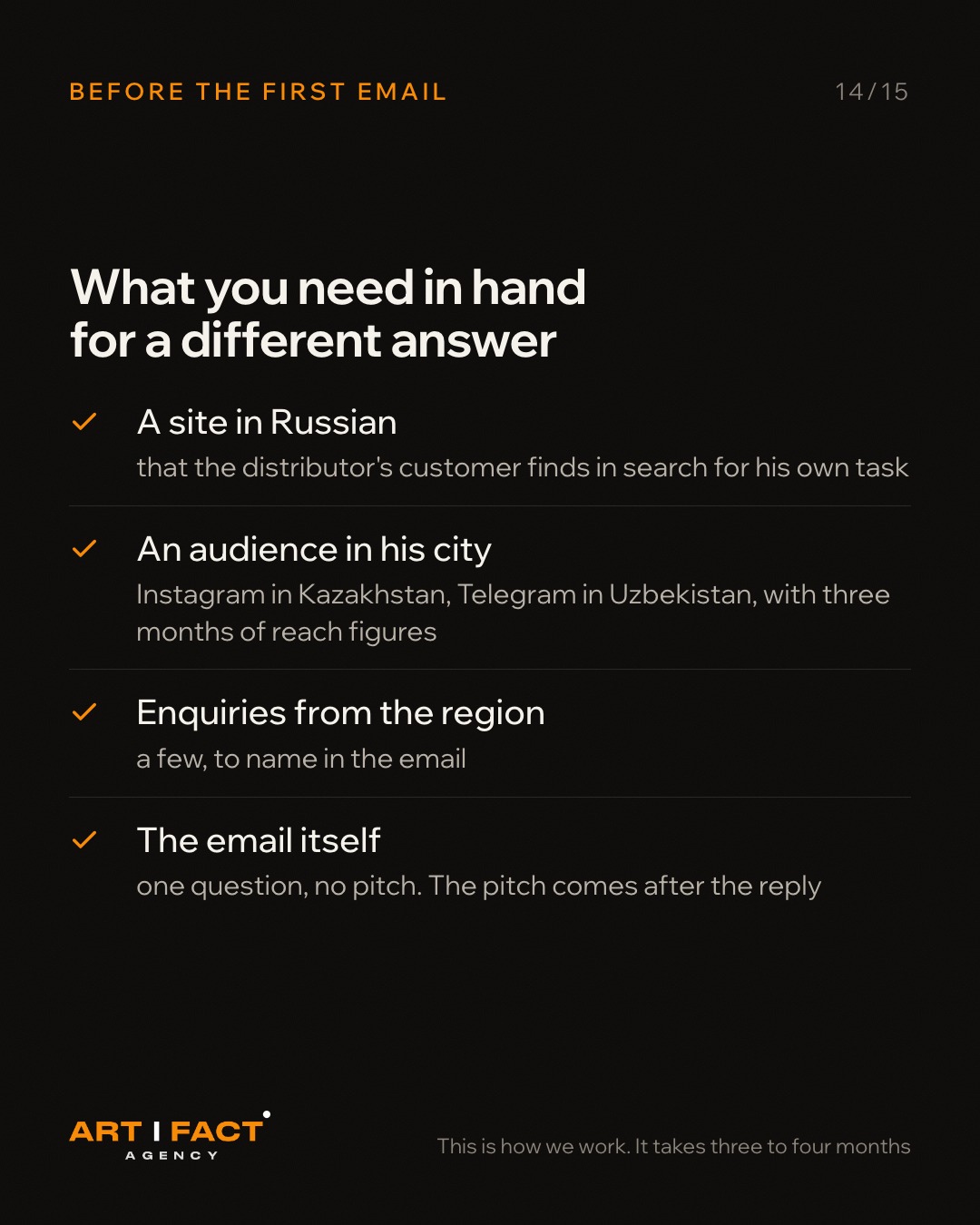
The first three or four months go on presence. A separate site for the region, in Russian. Instagram, with 13.1 million people in Kazakhstan and 14.1 million in Uzbekistan. Telegram, with 18-24 million in Uzbekistan by estimates. Ads aimed at the people who buy in your category, and pieces that get you found in search. In parallel we build a map of distributors from exhibitor lists and trade directories. We do not have a ready-made database; the map is built for each client.
The email to the distributor goes out when there is something to show in it: how many people from his region saw the brand over those months, how many wrote in themselves, what they asked. The email is short, with one question. The pitch comes after the reply. The budget question will come up then too, but now there is an answer to it: the budget is already working, and the figures show what it brought.
What presence does not do
It does not replace the distributor. Warehouse, credit terms and shelf stay with him, and you still have to negotiate them. It does not shrink the time to a contract to weeks: the 95-5 rule applies to you too, and most of your future buyers will buy after the campaign ends. If you sell plants, production lines or turnkey equipment, you usually do not need a distributor at all: there are dozens of buyers in a country, and we look for them directly. Presence in that case is built on the same channels, with fewer addressees, each known by name. And I have no statistics for the CIS on what share of distributors answer an unknown brand. There is only our own correspondence, and in it the budget question comes up more often than any other.
The same email, sent four months later, reads differently to the distributor. He types the name into search and finds a site in Russian, a page with followers from his own city, pieces about the product. His customers have already seen the name. At Artifact we do this work for the manufacturer: the first month costs $5,000, then 10-12 thousand a month.
Galina Sorokina
Sources
- 01puts itarindamp.substack.com
- 02discussion on IPVMipvm.com
- 03describeslinkedin.com
- 04spelled outlinkedin.com
- 05NAWnaw.org
- 06INFOLineretail.ru
- 07complainedkapital.kz
- 08breaks downprofiz.ru
- 09tellsprobusiness.io
- 10surveyedhbr.org
- 116sense6sense.com
- 12surveyednetimperative.com
- 1395-5 rulebusiness.linkedin.com
- 14wrotelinkedin.com
- 1513.1 milliondatareportal.com
- 1614.1 milliondatareportal.com
- 17estimatesspot.uz